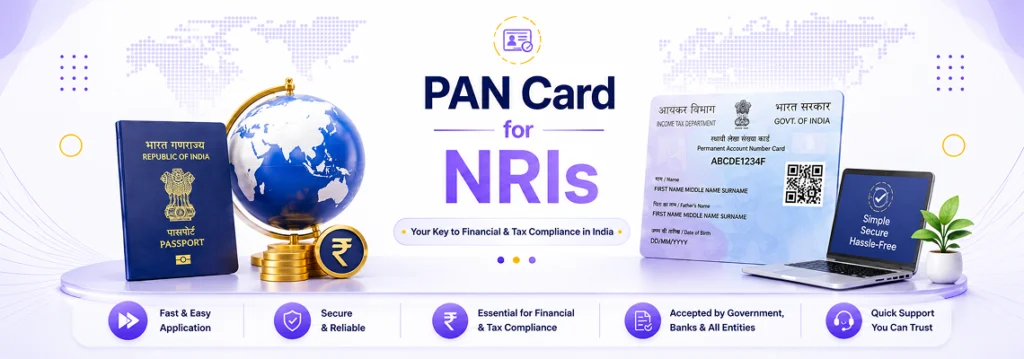
If you’ve been putting off getting a PAN card because you don’t live in India, this blog is for you.
A surprising number of NRIs believe PAN is only for people who file taxes in India — people who are present, earning, and paying tax locally. The reality is almost the opposite. If you own property in India, receive rental income, invest in mutual funds or stocks, or plan to repatriate money from an NRO account, you need a PAN. Without one, you’ll face higher tax deductions, blocked transactions, and real difficulty claiming refunds that are legally yours.
This blog covers what PAN is, exactly why it matters for NRIs, what happens if you don’t have one, and how to apply correctly under the new 2026 rules — from anywhere in the world.
What Is a PAN Card?
PAN stands for Permanent Account Number — a 10-character alphanumeric identifier issued by the Income Tax Department of India. It’s India’s primary tax identification number, used to track financial transactions, process tax deductions at source, and enable ITR filings.
For resident Indians, PAN is the financial system’s backbone. For NRIs, it’s the gateway to almost everything financial in India — investments, property, banking, and repatriation.
One important clarification upfront: having a PAN does not mean India taxes your global income. NRIs are taxed in India only on income sourced from India — rent, capital gains, dividends, interest on NRO accounts. Your overseas salary stays out of scope entirely. PAN simply ensures that what is taxable in India is handled correctly — at the right rate, not the penalty rate.
Do NRIs Need a PAN Card?
The honest answer: if you have any financial footprint in India, yes.
PAN is mandatory for NRIs in the following situations — and at least one of these will apply to most NRIs reading this:
Opening an NRE or NRO bank account. Banks require PAN as part of KYC compliance before opening any NRI bank account in India. No PAN, no account.
Investing in mutual funds or stocks. SEBI mandates PAN for all mutual fund investments and equity trading in India. Every AMC and broker will ask for it before accepting your application. This applies regardless of the amount.
Buying or selling property in India. PAN is required on both sides of any property transaction. When you sell property as an NRI, the buyer deducts TDS using your PAN. If you don’t provide one, the buyer must deduct TDS at the maximum applicable rate — which under Section 206AA of the Income Tax Act can reach 20% or higher, applied to the full sale consideration, not just the gain. Without PAN, your property transaction can stall entirely.
Receiving rental income. If a tenant pays you rent on Indian property, TDS rules apply. Your PAN is required for the TDS credit to be correctly recorded in your Form 26AS — the tax credit statement you need to file a refund claim later.
Filing an ITR. If your Indian income exceeds the basic exemption limit (₹2.5 lakh under the old regime, ₹4 lakh under the new regime), you must file an ITR-2. This is not possible without a PAN. Even below these thresholds, filing an ITR is the only way to claim refunds on TDS that has been over-deducted.
Repatriating money from an NRO account. Transferring funds abroad from an NRO account requires Form 15CA/15CB (now Forms 145/146) certification. Banks will not process the outward remittance without a valid PAN.
What Happens If You Don't Have a PAN?
This is where most NRIs feel the real cost of not acting.
Under Section 206AA of the Income Tax Act, if you don’t provide a PAN, the payer of your Indian income must deduct TDS at whichever is higher: the standard applicable rate, or 20%. For NRO interest that would normally attract 30% TDS, the difference is less dramatic — but for capital gains or other income types where standard rates are lower, the 20% floor under Section 206AA can significantly increase the deduction.
The good news is that PAN is straightforward to obtain from abroad, the process is fully online, and once you have it, it never expires.
Important 2026 Update — New Forms Replace the Old Ones
From 1 April 2026, the Income Tax Department introduced new PAN application forms under the Income Tax Rules 2026, replacing the old Form 49A and Form 49AA that many guides still reference. If you apply using the old forms, your application will be rejected.
The new forms for NRIs are:
Form 93 — for Indian passport holders living abroad (NRIs with Indian citizenship). This replaces the old Form 49A. Use this if you hold an Indian passport, regardless of which country you live in.
Form 95 — for OCI holders and foreign passport holders of Indian origin. This replaces the old Form 49AA. Use this if you hold a foreign passport — even if you were born in India or have Indian parents.
Your citizenship determines your form — not where you live. This is one of the most common errors in PAN applications from abroad, and it results in automatic rejection.
Other 2026 changes worth knowing:
- Mother’s name is now mandatory on Form 93 — applications with this field blank are rejected
- A Date of Birth proof document is now separately required (not just identity proof)
- A residential status field has been added — you must declare: Resident, NRI, or RNOR (Resident but Not Ordinarily Resident)
- NRIs do not need to link PAN with Aadhaar — NRIs without Aadhaar are exempt from Section 139AA linking requirements, as Aadhaar eligibility requires residing in India for 182+ days
What Documents Do You Need?
For NRIs applying on Form 93 (Indian passport holders):
- Valid Indian passport (serves as identity, date of birth, and address proof simultaneously)
- Overseas address proof — a bank statement, utility bill, or rental agreement showing your foreign address, issued within the last three months
- Two passport-size photographs (3.5 cm × 2.5 cm, colour, white background)
- Mother’s name details (now mandatory)
For OCI holders applying on Form 95:
- Valid foreign passport
- OCI card
- Overseas address proof
- Date of birth proof (if not evident from passport)
- Two passport-size photographs
No Aadhaar is required for either category. No Indian address is required. No apostille is needed for Indian passport holders applying on Form 93.
How to Apply — Your Two Routes
Route 1 — Directly through the government portals (Protean or UTIITSL)
Applications can be submitted online through Protean (formerly NSDL) or UTIITSL — the two government-authorised agencies. You complete the online form, upload your documents, pay the fee, and send the signed acknowledgement with supporting documents to the processing centre in India.
The fee is ₹107 for delivery to an Indian address, or approximately ₹994–1,017 for delivery to a foreign address (includes international courier charges and GST). Physical delivery to an overseas address is available to most NRI countries via DHL or FedEx.
The known challenge with the direct portal route for overseas applicants: both portals require an Indian mobile number for OTP verification, and payment systems often reject foreign-issued cards. If you encounter these barriers, Route 2 is the practical alternative.
Route 2 — Let our team handle it end to end
This is what we do for our clients — and it removes every friction point of the direct portal route.
We manage the entire PAN application process on your behalf: reviewing your documents against current 2026 requirements, completing the correct form (Form 93 or Form 95 depending on your citizenship), submitting to the processing centre, tracking your application, and handling any queries that come up during processing. You don’t need an Indian mobile number, an Indian address, or any knowledge of the Protean or UTIITSL portals.
Our fee for end-to-end PAN card assistance is USD 40–60 depending on your citizenship category and location. The ePAN typically arrives by email within 5–7 working days of your documents being received. The physical card follows within 2–3 weeks to your overseas address.
We’ve helped many NRI clients across Australia, USA, UK, and UAE get their PAN correctly and on first attempt — with no rejections, no chasing, and no time zone headaches. If you’re ready to get started, get in touch with our team and we’ll take it from there.
Already Have a PAN? Two Things to Check
Update your residential status. If you applied for a PAN as a resident Indian and have since become an NRI, your PAN record should reflect your current NRI status. This ensures the correct TDS rates are applied and avoids discrepancies during ITR filing. Use Form PAN CR-01 (corrections) through the Protean or UTIITSL portal — it’s free and typically takes 7–15 days.
Check your PAN is active. An inactive PAN (due to name mismatches or other flags in the system) can block transactions at critical moments — particularly property sales or large investment redemptions. Verify your PAN status on the Income Tax e-filing portal. If inactive, correct the underlying issue and reactivate before your next transaction.
PAN Is Step One — Then You Can Invest
PAN by itself doesn’t do anything. It’s the prerequisite that unlocks everything else: your NRE account, your mutual fund KYC, your SIP mandate, your ITR refund claim, your property sale, your repatriation.
Think of it as your financial passport to India. Once it’s in place, everything that follows — the investing, the tax planning, the building of a portfolio from abroad — becomes clean, structured, and compliant.
For many of our clients, the PAN card is where the whole journey begins. We handle the application start to finish — you send us your details, we do the rest, and your PAN arrives within days. From there, we help you set up your NRE account, complete your KYC, and start investing — all managed remotely, all compliant from day one.
Ready to get your PAN sorted? Contact our team. It takes 5 minutes to get started and we’ll handle everything from there.
Frequently Asked Questions
Disclaimer: This article is for general informational purposes only and does not constitute financial, legal, or tax advice. PAN application requirements, form names, fees, and processing timelines are subject to change. The information reflects the position as of May 2026, including changes introduced under the Income Tax Rules 2026 effective 1 April 2026. Individual circumstances vary — consult a qualified chartered accountant for personalised guidance on your PAN and tax obligations in India.