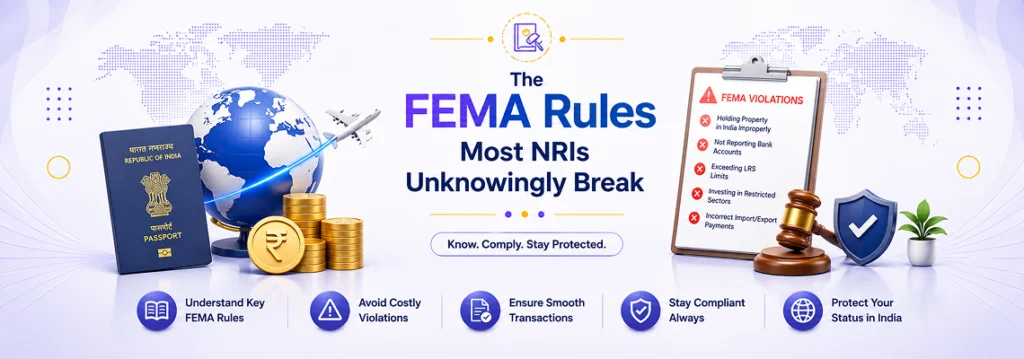
Most FEMA violations by NRIs are not deliberate. Nobody moves to Dubai or Sydney and thinks, “I’ll just ignore India’s foreign exchange laws.” What actually happens is simpler and more common: life gets busy, the paperwork feels overwhelming, a bank never flagged anything, and years pass.
Then something triggers a review, a property sale, a repatriation attempt, a bank’s routine KYC audit, and what seemed like a minor oversight turns into a regulatory problem that’s expensive and time-consuming to fix.
The Foreign Exchange Management Act governs every cross-border financial transaction an NRI makes involving India. It determines which accounts you can hold, what you can invest in, how you can move money, and what you can own. Penalties for violations can reach three times the amount involved, plus ₹5,000 per day for continuing violations.
The good news: every violation listed below is avoidable. Most are also fixable through a voluntary compounding process if they’ve already occurred. But the starting point is knowing what the rules actually are.
Violation 1, Continuing to Use a Resident Savings Account After Becoming an NRI
This is the single most common FEMA violation among NRIs, and arguably the most costly.
The moment you become an NRI under FEMA (once you’ve spent more than 182 days outside India in a financial year), you are legally required to convert your resident savings account to an NRO account. Continuing to operate a resident savings account after that point is a direct violation of FEMA, not a grey area.
What makes this so common is that banks don’t always catch it. They may not know you’ve moved abroad unless you tell them. Some NRIs operate resident accounts for years assuming silence means compliance. It doesn’t.
What it costs you: Penalties can reach up to three times the account balance involved in the contravention. Banks, when they eventually discover the mismatch during a KYC review, can freeze the account entirely until conversion and regularisation are completed. Real cases have resulted in penalties of ₹1.5 lakh and above, before any compounding settlement.
What to do instead: Convert your resident savings account to NRO as soon as you establish NRI status, ideally within 30–60 days of securing your overseas address proof. This is not difficult; it can be done by couriering attested documents to your bank. Your resident fixed deposits become NRO FDs on conversion. Notify your broker and mutual fund folios at the same time.
Violation 2, Trading Stocks Through a Resident Demat Account as an NRI
Closely linked to Violation 1, but distinct enough to warrant its own section, because many NRIs who correctly convert their savings account forget entirely about their demat and trading accounts.
Once you become an NRI, you cannot trade Indian equities through a resident demat account. You need an NRI demat account and, for buying listed shares on a repatriable basis using NRE funds, a Portfolio Investment Scheme (PIS) account linked to your NRE account. Continuing to trade through a resident account while holding NRI status is a FEMA violation.
What it costs you: Penalties can reach three times the value of all transactions made through the non-compliant account. Brokers are increasingly flagging these mismatches during KYC reviews, if your broker discovers you’ve been trading as an NRI through a resident account, they can freeze the account and report the transactions to the RBI.
One important clarification: PIS is required for repatriable stock delivery trades using NRE funds. Mutual fund investments do not require PIS, they can be made through a regular NRE or NRO account. Futures and options trading is permitted through a non-PIS NRO account. The routing matters, and getting it wrong in either direction creates a violation.
What to do instead: Inform your depository participant (CDSL or NSDL) and broker of your NRI status as soon as it changes. They will guide the redesignation process. This should happen in parallel with your bank account conversion, not as an afterthought months later.
Violation 3, Opening a New PPF Account (or Continuing One Without Knowing the Rules)
PPF, the Public Provident Fund, is one of India’s most beloved savings instruments. Tax-free returns, government-backed, Section 80C benefit. The problem for NRIs is that FEMA prohibits them from opening new PPF accounts entirely.
Many NRIs don’t know this. Some open PPF accounts after moving abroad, not realising their status has changed. Others had PPF accounts as residents and continue contributing past the point they should have stopped.
The rules as they stand:
- You cannot open a new PPF account as an NRI. Full stop.
- If you had a PPF account before becoming an NRI, you can continue contributing to it and earning interest until the 15-year maturity date, but you cannot extend it beyond maturity.
- From October 2024, PPF accounts held by NRIs that have been irregularly extended past maturity stop earning interest entirely.
- Upon maturity, an NRI must close the account. There is no option to extend.
What it costs you: If you’ve been contributing to a PPF account as an NRI (either a new one or one that’s been extended), those contributions may be treated as irregular. The interest earned on irregular contributions is at risk of being voided, and the violation can attract regulatory attention.
What to do instead: Check your PPF account’s status and maturity date. If you are within the 15-year tenure and the account predates your NRI status, you can continue, but plan for closure at maturity. Do not open a new one. Consider NRE FDs or mutual funds as tax-efficient alternatives that are fully permitted.
Violation 4, Buying Prohibited Property, Agricultural Land, Plantation, or Farmhouse
NRIs can buy residential and commercial property in India freely, no RBI approval required. What most people don’t realise is how narrow that permission is.
Under FEMA, NRIs are strictly prohibited from purchasing agricultural land, plantation property, or farmhouses in India. This is not a technicality, it is a hard prohibition, regardless of intent or how the transaction is structured.
What it costs you: The penalty for purchasing prohibited property is severe, up to three times the transaction value, plus the real possibility of property confiscation. In documented cases, penalties have reached ₹25 lakh or more, with confiscation proceedings initiated.
The grey areas NRIs commonly misunderstand:
- Inheritance is permitted. If you inherit agricultural land from a family member, you can hold it, but you cannot purchase it.
- You can receive agricultural land as a gift from a resident relative, but you cannot buy it.
- “Farmhouse” in FEMA’s language has a specific legal meaning that can include properties marketed as weekend homes or villas in agricultural zones. Check the land-use classification before purchasing any rural or semi-rural property.
What to do instead: Before any property purchase, verify the land-use classification in the registration documents, not just the marketing description. If you have any doubt about whether a property qualifies as agricultural, get a legal opinion before signing anything.
Violation 5, Repatriating More Than USD 1 Million from an NRO Account in One Financial Year
This one catches NRIs off guard most commonly during property sales, when large sums suddenly need to move abroad quickly.
The repatriation limit from NRO accounts is capped at USD 1 million per financial year (April–March). This covers everything coming out of NRO, property sale proceeds, rental income, dividends, fixed deposit maturities. Once you hit the cap, you cannot repatriate more from NRO within that financial year without RBI approval.
The mistake NRIs make is assuming that because the money is legitimately theirs and taxes have been paid, they can move it freely. Paying tax does not override the repatriation limit. The cap applies regardless.
What it costs you: Attempting to repatriate beyond the limit without RBI approval is a FEMA contravention. Banks acting as authorised dealers are required to flag these attempts. If funds are moved improperly, the transaction can be reversed, penalties applied (up to three times the excess amount), and you may face formal proceedings.
What to do instead: Plan large repatriations, particularly property sale proceeds, across financial years where the amount exceeds USD 1 million. If you need to repatriate more in a single year, apply for RBI approval through your authorised dealer bank before initiating the transfer. This process takes time, so plan well ahead of any property settlement date.
Violation 6, The FEMA vs Income Tax Status Mismatch Nobody Warns You About
This is the most conceptually confusing violation, and the one that creates the most unintended non-compliance.
FEMA and the Income Tax Act use different definitions of NRI status. Under FEMA, the test is simple: if you spent more than 182 days outside India in a financial year, you are an NRI. Under the Income Tax Act, the test is more complex, it considers your stay over two years, seven years, and ten years.
The result: in the same financial year, you can be a resident under the Income Tax Act but an NRI under FEMA. This is not a contradiction, it is how the law is written. But most NRIs (and even some advisors) don’t realise the two statuses can diverge.
Why this matters: Your bank account permissions, investment routes, and repatriation rights follow your FEMA status. Your tax obligations follow your Income Tax status. If you’re following the Income Tax definition for FEMA purposes, believing you’re still a resident, you may be operating accounts and making investments that are only permitted for residents, which is a FEMA violation even if your tax filing is perfectly correct.
A real example: An NRI moves to the UK in January of a financial year. She spends 270 days in India and only 95 days in the UK that year. Under FEMA, she is still a resident (hasn’t crossed 182 days abroad). Under the Income Tax Act, depending on her history, she may or may not be a resident. The year after, she spends 210 days in the UK. She is now an NRI under FEMA, and must convert accounts immediately, even if her Income Tax status for that year is still being assessed.
What to do instead: When you move abroad, get clarity on both your FEMA status and your Income Tax status from a qualified advisor, they are not the same question. Don’t assume one tells you about the other.
Already in Violation? What You Can Do
If you’ve read this and recognised a past or current violation, don’t panic, but don’t delay either.
FEMA has a voluntary compounding mechanism that allows NRIs to regularise contraventions by paying a settlement amount to the RBI rather than going through formal adjudication. Under the Foreign Exchange (Compounding Proceedings) Rules, penalties for many technical violations are now capped at ₹2 lakh per contravention, a significant reduction from earlier approaches where penalties were calculated as a percentage of the full amount involved.
The key principle: voluntary disclosure is always better than waiting to be found. The longer a violation continues, the higher the daily penalty accrual (₹5,000 per day for continuing violations), and the less sympathetic the compounding authority will be.
If you’re unsure whether your current account structure, investment holdings, or past transactions are compliant, a review with a qualified CA or FEMA advisor is the most cost-effective thing you can do.
Our team works with NRIs across Australia, USA, UK, and UAE to structure their India finances correctly from the start, so compliance is built in, not bolted on after something goes wrong.
Frequently Asked Questions
Disclaimer: This article is for general informational purposes only and does not constitute legal, financial, or regulatory advice. FEMA regulations, penalty structures, and RBI guidelines are subject to change. The information reflects the position as of May 2026. Individual circumstances vary significantly, consult a qualified chartered accountant or FEMA advisor before making decisions about your account structure, investments, or past compliance positions. If you believe you may have committed a FEMA violation, seek professional advice promptly.