

If you’re an NRI managing money between two countries, you’ve almost certainly come across these three account types, NRE, NRO, and FCNR. And if you’re honest, the difference between them probably still isn’t entirely clear.
You’re not alone. Most NRIs open whichever account their bank suggests first, then discover later that they’ve been routing the wrong money into the wrong place. The result: unnecessary tax deductions, repatriation complications, and sometimes outright FEMA violations.
This guide cuts through the confusion. It’s not a deep dive into any one account, we’ve covered NRE and NRO in detail separately, but a clear, practical map of how all three work, what each one is for, and how to use them together.
Why You Can't Just Use One Account
As an NRI, you cannot hold a standard resident savings account in India. Once you become an NRI under FEMA, your resident accounts must be converted. In their place, the Reserve Bank of India gives you three account types, each designed for a specific type of money.
The simplest way to think about it: the account that’s right for your money depends on where that money came from, not how much it is.
The Three Accounts, What Each One Is For
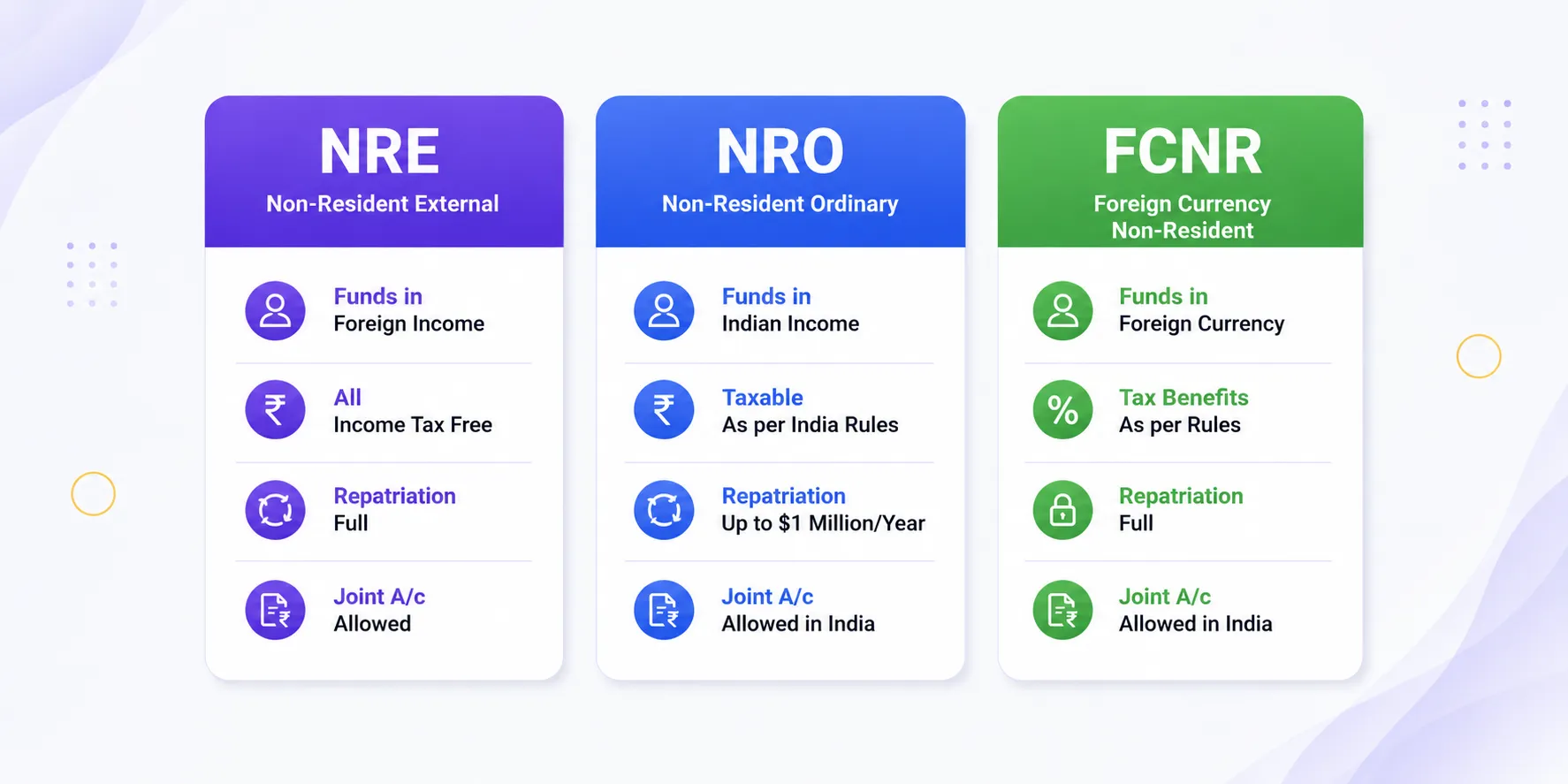
NRE Account, For Your Foreign Earnings
NRE stands for Non-Resident External. This account is designed for money you’ve earned abroad, your salary, savings, business income from outside India. When you send foreign currency into an NRE account, it converts to Indian rupees.
The headline benefits are significant: interest is completely tax-free in India, and both the principal and interest are fully repatriable, you can send it back abroad at any time with no annual cap. This makes it the natural home for investment capital that you may want to bring back overseas one day.
NRE accounts can be held as savings accounts or fixed deposits. NRE FDs currently offer rates of around 6.50–7.25% p.a. depending on the bank and tenure, and that interest reaches you with zero Indian tax deducted.
The key restriction: only foreign earnings can go into an NRE account. India-sourced income, rent, dividends, pension, cannot be deposited here.
NRO Account, For Your India-Sourced Income
NRO stands for Non-Resident Ordinary. This account handles money that originates in India, rental income from a property, dividends from Indian stocks or mutual funds, pension payments, interest from existing deposits, or proceeds from selling Indian assets.
Unlike the NRE account, NRO interest is taxable in India at 30% plus surcharge and cess, deducted at source. Repatriation from an NRO account is permitted but capped at USD 1 million per financial year, and requires tax clearance documentation.
If India has a Double Taxation Avoidance Agreement with your country of residence, and it does with over 90 countries including the US, UK, UAE, and Australia, you may be able to reduce the tax rate on NRO interest by providing a Tax Residency Certificate and Form 10F. This doesn’t eliminate the tax, but it can reduce it meaningfully.
Most NRIs need an NRO account. If you own property in India, receive any income from Indian sources, or are selling Indian assets, the proceeds have to go somewhere compliant, and NRO is that place.
FCNR Account, For Protecting Against Currency Risk
FCNR stands for Foreign Currency Non-Resident. It is a fixed deposit account, not a savings account, that holds your money in foreign currency rather than converting it to rupees.
This is the key distinction. With an NRE FD, your money is held in rupees. If the rupee depreciates over your deposit tenure, the value of your savings in dollar or pound terms falls when you repatriate. With an FCNR deposit, your money stays in USD, GBP, EUR, AUD, CAD, or JPY for the entire term, so you face no currency conversion risk during the deposit period.
FCNR deposits are available for tenures of 1 to 5 years, with a minimum deposit of around USD 1,000. Interest is tax-free in India, and both principal and interest are fully repatriable with no annual cap, the same repatriation freedom as NRE accounts.
Current FCNR interest rates vary by currency and bank, typically ranging from around 4.10% (GBP) to 4.40% (USD) p.a. These are lower than NRE FD rupee rates of 6.5–7.25%, but the comparison isn’t straightforward, NRE FD returns are in rupees, which depreciate roughly 3–4% annually against major currencies. Once you account for currency movement, FCNR deposits often deliver comparable or better real returns in your home currency for NRIs who plan to use the money abroad.
The Clearest Way to Tell Them Apart
The single question that determines which account your money belongs in:
Where was this money earned?
- Earned abroad (salary, savings, overseas business income) → NRE account
- Earned in India (rent, dividends, pension, asset sale proceeds) → NRO account
- Earned abroad and you want no currency conversion risk for 1–5 years → FCNR deposit
That’s it. The mistake most NRIs make is depositing India-sourced income into an NRE account, which is a FEMA violation, or sending foreign salary into an NRO account unnecessarily, triggering avoidable 30% TDS.
How the Three Accounts Sit Side by Side
Table here {}
Can You Hold All Three? Yes, and Most NRIs Should
There is no rule that limits you to one account type. In practice, most NRIs benefit from holding all three, each serving a distinct purpose.
A typical setup looks like this: your NRE account receives your monthly foreign salary and is the account you use for investing in Indian mutual funds, NRE FDs, and other rupee-denominated instruments. Your NRO account receives rental income from your Indian property, dividend credits from your stock portfolio, and any proceeds from asset sales in India. Your FCNR deposit holds a portion of your liquid foreign savings for a fixed term, earning interest without currency conversion exposure, useful if you plan to use the funds abroad in 2–3 years.
This structure keeps every rupee in the right place, minimises tax leakage, and keeps your repatriation options clean.
The Mistakes That Cost NRIs Money
Routing Indian income into an NRE account. This is a FEMA violation. Rental income, dividends, and pension must go to NRO, not NRE. Banks may catch and flag this, and penalties can apply.
Ignoring the NRO tax. NRO interest at 30% TDS is steep. Many NRIs don’t realise they can reduce this through DTAA documentation, a Tax Residency Certificate from their home country, filed before interest is credited. Without it, you pay full Indian tax rates when a treaty rate may apply.
Choosing NRE FD when FCNR is more appropriate. If you know you’ll need the money in USD, GBP, or AUD in 2–3 years, an NRE FD exposes you to rupee depreciation risk on redemption. FCNR removes that risk entirely. It’s not the right choice for every NRI, but for those with a clear foreign-currency need, it’s significantly better.
Not converting resident accounts on time. Once you become an NRI, resident savings accounts must be converted to NRO (or closed). Continuing to hold and operate a resident account after becoming an NRI is a FEMA violation, regardless of how long you’ve held the account.
Which Account Should You Open First?
If you’re just getting started:
Open an NRE savings account first, this is where your foreign salary goes, it earns tax-free interest, and it’s the account from which you invest in India. This is the foundational NRI account.
Open an NRO savings account as soon as you have income in India, rental income, dividends, or anything else earned on Indian soil. If you don’t yet have India-sourced income, you can wait.
Consider an FCNR deposit once you have a meaningful lump sum in foreign currency, typically USD 10,000 or more, that you want to park safely for 1–3 years without rupee exposure.
The right structure depends on your specific income sources, investment goals, and timeline. Our team helps NRIs set up their account structure correctly from the start, so the right money flows into the right place, and nothing gets unnecessarily taxed or restricted.
Frequently Asked Questions
What is the main difference between NRE and NRO accounts?
The key difference is the source of funds and tax treatment. NRE accounts hold foreign earnings and offer tax-free interest in India with unlimited repatriation. NRO accounts hold India-sourced income (rent, dividends, pension) and attract 30% TDS on interest, with repatriation capped at USD 1 million per financial year. Both accounts hold money in Indian rupees.
What is an FCNR account and who should use it?
An FCNR account is a fixed deposit that holds your money in foreign currency, USD, GBP, EUR, AUD, CAD, or JPY, rather than converting it to rupees. Interest is tax-free in India and the deposit is fully repatriable. It suits NRIs who want to earn interest on foreign savings without taking on currency conversion risk, particularly those who plan to use the funds abroad at maturity rather than in India.
Can an NRI hold all three accounts, NRE, NRO and FCNR?
Yes, and most NRIs benefit from holding all three simultaneously. Each account serves a distinct purpose: NRE for foreign earnings and investments, NRO for India-sourced income, and FCNR for fixed-term foreign currency deposits. There is no regulatory limit on holding all three at the same bank or across different banks.
Is FCNR better than NRE for fixed deposits?
It depends on your currency needs. NRE FDs offer higher headline interest rates (6.50–7.25% p.a.) but in rupees, which depreciate roughly 3–4% annually against major currencies. FCNR rates are lower (typically 4.10–4.40% p.a.) but in your home currency with no conversion risk. If you plan to use the funds in India, NRE FD is usually better. If you’ll need the funds abroad, FCNR often delivers a better real return in your home currency.
What happens to NRE, NRO and FCNR accounts when an NRI returns to India permanently?
When you return to India and become a resident, your NRE and NRO accounts must be redesignated to resident savings accounts or converted. FCNR deposits can be held until maturity at the contracted interest rate, then converted to a Resident Foreign Currency (RFC) account or a resident rupee deposit. Interest earned on FCNR deposits becomes taxable in India from the date you resume resident status.
Disclaimer: This article is for general informational purposes only and does not constitute financial, legal, or tax advice. Account rules, interest rates, tax rates, and FEMA regulations are subject to change. The information reflects the position as of May 2026. Individual circumstances vary, consult a qualified financial advisor and chartered accountant before opening or restructuring your NRI accounts.