

Who Is Eligible to Invest in Indian Mutual Funds?
Any individual classified as a Non-Resident Indian (NRI), Overseas Citizen of India (OCI), or Person of Indian Origin (PIO) under FEMA (Foreign Exchange Management Act) can invest in Indian mutual funds.
However, eligibility and access are two different things. And this is where things get important.
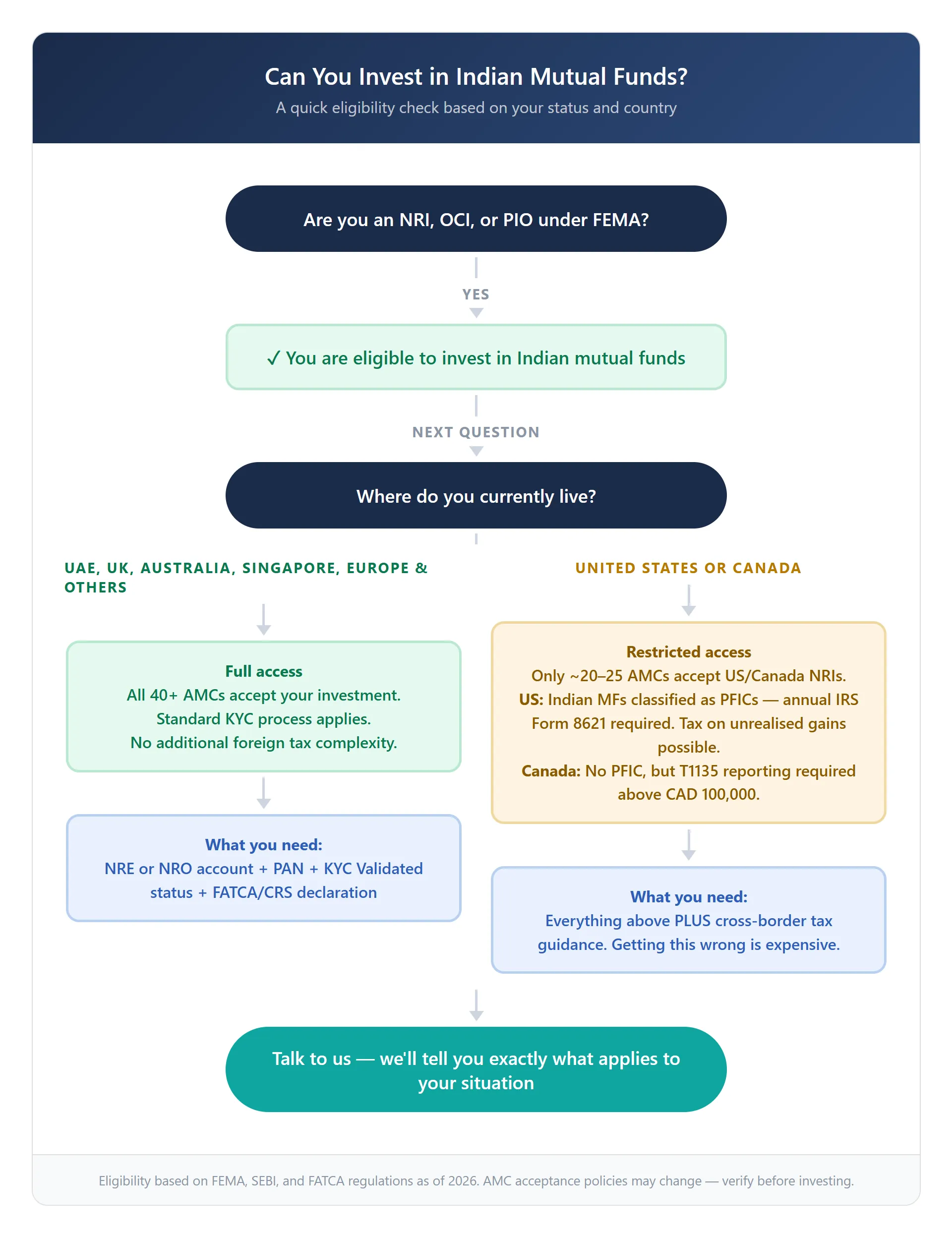
The US and Canada Restriction, This Matters More Than Most NRIs Realise
If you’re based in the US or Canada, your options are significantly more limited, and the tax implications are genuinely complex.
This is exactly why we strongly recommend talking to us before investing if you’re based in the US or Canada. The rules are complex, the penalties for non-compliance are severe, and the right approach depends entirely on your specific situation. We help US and Canada NRIs navigate this properly, including identifying which AMCs accept your investment and how to structure things to minimise cross-border tax complications. “US-based NRI investing guide”
How NRI Mutual Fund Investing Actually Works
You Must Invest Through an NRE or NRO Account
Mutual funds in India can only be purchased in Indian Rupees. You cannot invest in foreign currency. This means you need an Indian bank account, specifically an NRE or NRO account. “NRE vs NRO account“
Investing through an NRE account means your investment proceeds are fully repatriable, when you redeem, you can send the money back abroad freely. This is the route most NRIs prefer.
means your investment proceeds are fully repatriable, when you redeem, you can send the money back abroad freely. This is the route most NRIs prefer.
Investing through an NRO account means repatriation is capped at USD 1 million per financial year across all NRO accounts, and you’ll need Form 15CA/15CB for transfers above certain thresholds.
KYC Must Be "Validated" Status
SEBI now requires all mutual fund investors, including NRIs, to have KYC “Validated” status. An older “Registered” KYC is no longer sufficient for new investments. The validation process involves additional identity verification, and for NRIs, the documentation requirements differ based on your country of residence.
This is one of the areas where NRIs face the most delays and rejections. The attestation requirements, document formats, and In-Person Verification rules vary by country, and SEBI’s norms have been evolving since 2024. We handle KYC for NRIs across 30+ countries and know exactly what each jurisdiction requires.
FATCA and CRS Declarations Are Mandatory
Regardless of your country, you’ll need to submit FATCA and CRS (Common Reporting Standard) self-declarations as part of your KYC. These confirm your global tax residency and allow Indian institutions to comply with international reporting requirements. It’s a one-time form, usually built into the KYC process.
Why Mutual Funds Are the Best Starting Point for Most NRIs
Professional management from a distance. You don’t need to track the Indian market daily, pick individual stocks, or make constant decisions from a different time zone. A fund manager does that for you.
SIPs make it automatic. A Systematic Investment Plan lets you invest a fixed amount every month, starting from as little as ₹500, without any manual intervention after setup. It builds discipline and benefits from rupee cost averaging over time. “how to start a SIP as an NRI“
How Mutual Funds Are Taxed for NRIs
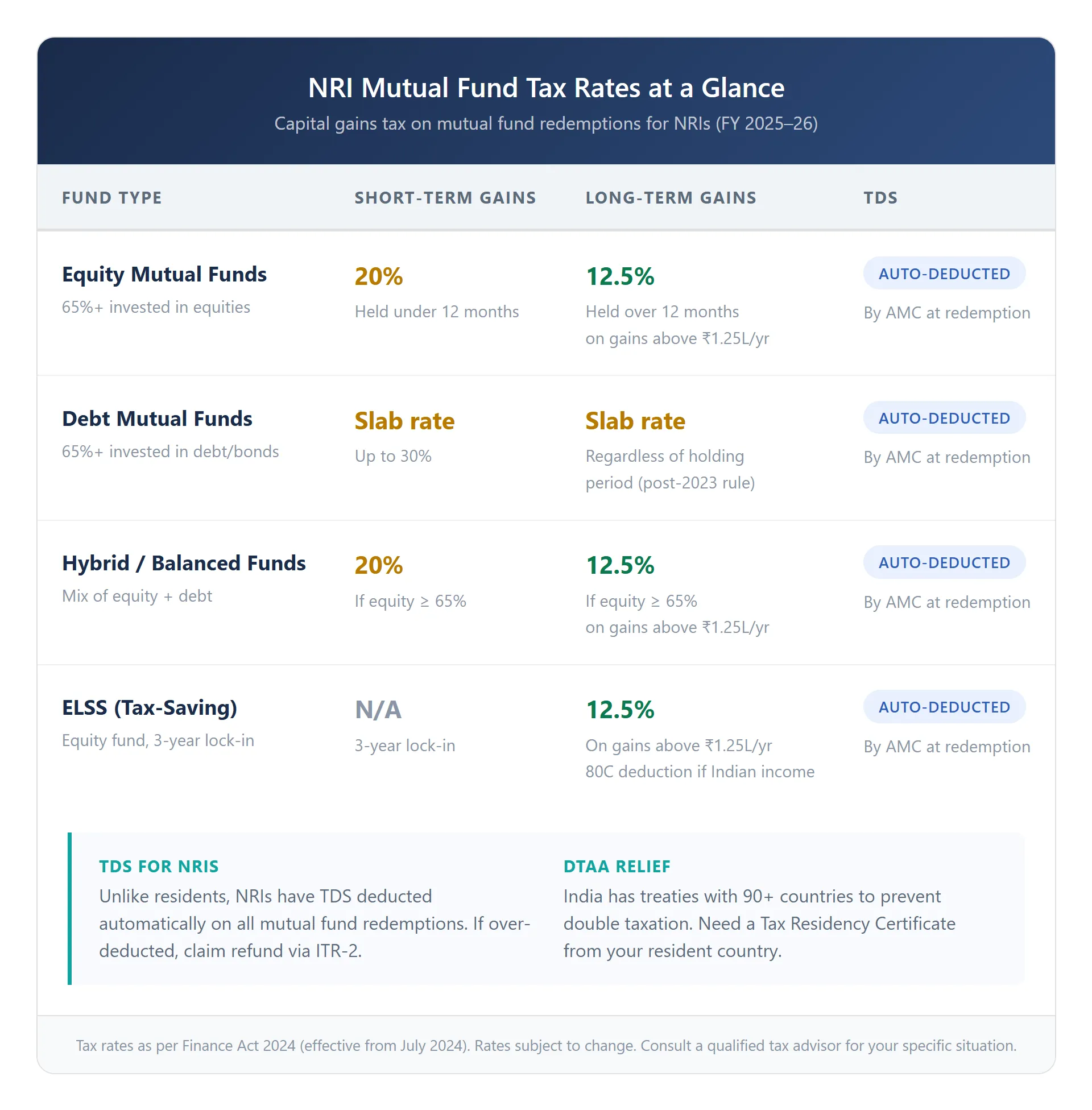
Tax is where mutual funds get an unfair reputation for being “complicated.” In reality, the rules are clear, you just need to know them. “NRI mutual fund taxation in detail“
DTAA prevents double taxation. If your country of residence has a Double Taxation Avoidance Agreement with India (over 90 countries do), you can claim credit for taxes paid in India against your home country tax obligation. You’ll need a Tax Residency Certificate to do this.
Common Mistakes NRIs Make with Mutual Funds
Ignoring KYC status. Many NRIs have KYC in “Registered” status from years ago. SEBI now requires “Validated” status, and your existing investments may be frozen for fresh transactions if this isn’t updated.
Frequently Asked Questions
Can US and Canada NRIs invest in Indian mutual funds?
Can NRIs invest in mutual funds online from abroad?
What is the minimum amount to start investing in mutual funds as an NRI?
Are mutual fund returns taxable for NRIs in India?
Should NRIs choose direct or regular mutual fund plans?
Let Us Set It Up for You
Disclaimer: This article is for informational purposes only and does not constitute financial, tax, or legal advice. Tax laws and FEMA regulations are subject to change. Mutual fund investments are subject to market risks, please read all scheme-related documents carefully. Consult a SEBI-registered investment advisor and a qualified tax professional before making investment decisions.